Field note 07 / Transformation
Transforming products are judged between states
The tote and the backpack are easy to photograph. The transition is where the design earns its place.
Name both states precisely
Notabag is described in the catalog as a tote-to-backpack design. Solgaard’s entry centers on shelving inside luggage, while Lalo represents convertible furniture. These ideas operate at very different scales. What connects them is a claim that one physical system can support more than one configuration. A critique should name those configurations before praising versatility.
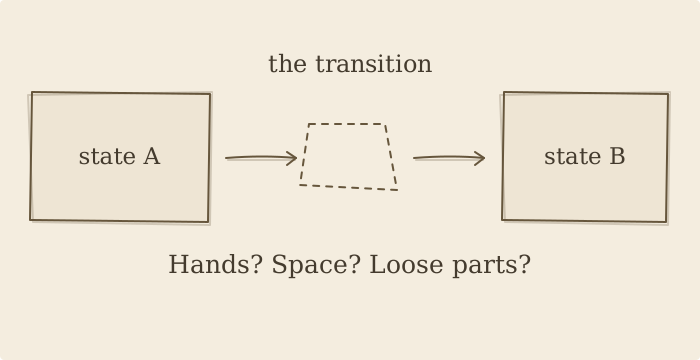
Study the middle, not the endpoints
Draw the action that takes the object from one state to the other. How many hands are occupied? Does it require setting anything down? Must contents be removed? Is a component temporarily detached? The answers may change with load, surroundings, and user. A smooth empty demonstration does not establish the same experience with real contents.
Look for an unmistakable finish
A transition needs a clear end state. If the user is unsure whether a strap, joint, or shelf is in position, the form has not fully communicated its status. Use the manufacturer’s instructions and limits for any actual conversion, particularly furniture. This article is not a safety assessment. The design question is whether the intended state is legible before someone relies on it.
Ask what the extra state costs
An additional configuration can introduce weight, bulk, complexity, or compromise in the main configuration. Those costs should be measured rather than assumed. Start with the use case that occurs most often and ask whether the secondary state makes it worse. A successful transformation is one that answers a specific recurring need, not simply one that creates an impressive demonstration.
Objects referenced
- Notabag · NotabagTote-to-backpack transformer. Brand reference · Catalog record
- Solgaard · Carry-On ClosetSuitcase with built-in shelving. Brand reference · Catalog record
- Lalo · The ChairConvertible design baby gear. Brand reference · Catalog record
Method: AI-assisted desk analysis of the dated Creative DTC catalog, not hands-on testing. Product formats are attributed to the linked records and brand references; interpretations and sketch prompts are editorial. Brand pages may change. Price, availability, performance, compatibility, and impact are not verified here.
Explore the transformation collection